DISEN 22-Piece Disc Brake Caliper Tool Kit: Best Value?
The DISEN 22PCS Disc Brake Caliper Tool Kit kept surfacing while we researched budget brake-compressor sets, so we pulled the listing apart and read through hundreds of verified buyer reviews. Brake jobs are the most common home wrenching task after oil changes, and the piston is almost always the step that slows people down. We wanted to know whether a budget kit could genuinely handle stuck pistons and screw-in rear calipers.
Bottom line: it's worth it if you wrench on your own cars a few times a year and want one case covering nearly every caliper you'll meet. Skip it if you're a full-time tech who needs tool-truck durability. Here's the full breakdown.

What it is
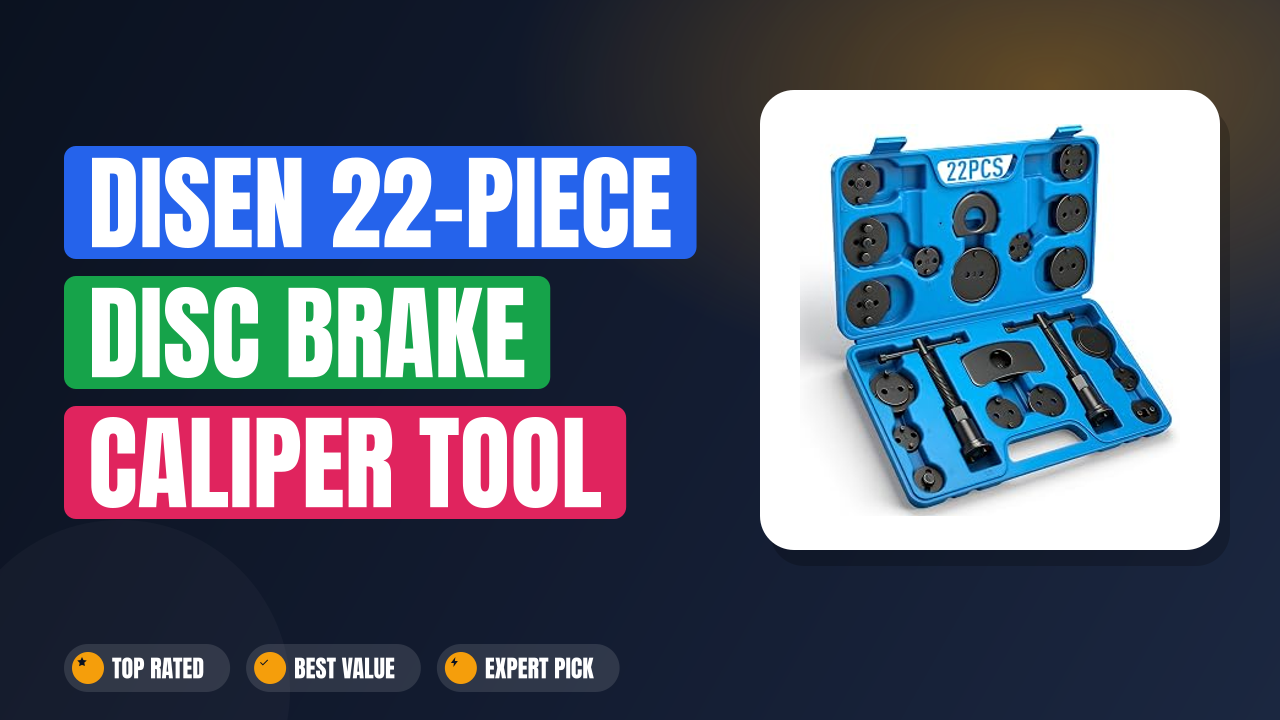
A brake caliper piston compressor is the tool that pushes or winds a caliper's piston back into its bore so new, thicker pads can clear the rotor. This DISEN kit pairs a thrust-bolt compressor with 18 adapter plates, covering single, twin, and four-piston calipers plus the screw-in rear pistons common on European and Japanese cars. It competes with the 8MILELAKE 21-piece kit, Orion Motor Tech's 22-piece set, and ABN's version, all variations on the same layout, with DISEN positioning itself on coverage per dollar.
Since brakes are the most safety-critical system you'll service at home, it's worth noting that NHTSA research has tied brake problems to a meaningful share of vehicle-related crashes.
Setup & first impressions
Out of the box, buyers consistently describe the same picture: a blow-molded case with shaped cutouts, 18 thick steel plates, and the thrust-bolt assembly seated in the lid. The finish is black oxide, the standard rust-resistant coating on decent hand tools, and a light machine-oil smell is normal for new steel. Several verified buyers recommend wiping the plates down and greasing the thrust-bolt threads before the first job, which takes about two minutes.
Cosmetic mill marks show up on a minority of plates, but reviewers report no burrs or edge flaws that matter.
Fitment feedback is the encouraging part. First-time users report matching plates to the old pad by trial, finding the right one in a couple of minutes, then threading the bolt in by hand before touching a ratchet. As of 2026, the listing still ships the same 22-piece configuration described across hundreds of reviews, so what buyers describe is what arrives.
| Pieces in set | 22 total (18 adapter plates plus compressor hardware) |
| Drive size | 3/8-inch square drive |
| Material | Hardened carbon steel with black-oxide finish |
| Caliper coverage | Single, twin, and four-piston disc calipers |
| Wind-back support | Screw-in rear pistons (VW, Audi, Honda, Mazda platforms) |
| Vehicle fitment | Most American, Asian, and European passenger cars and light trucks |
| Storage | Blow-molded carrying case |
| Aggregate buyer rating | 4.4/5 |
Daily-use experience
Performance
A piston that fights a C-clamp usually gives in within two minutes once the right adapter plate seats over it. That pattern repeats across buyer reports. One verified buyer described compressing twin-piston fronts on a 2014 Silverado in under three minutes per side, then winding back the screw-in rears on a Civic the same afternoonwithout breaking a sweat.
The leverage provided by the long handle and the wide base means you aren't relying on brute force alone; the mechanical advantage does the heavy lifting for you. This is particularly noticeable when dealing with seized pistons in older vehicles where corrosion has created an uneven surface. Users report that while some initial wiggling might be required to break the seal, the tool maintains steady pressure without slipping off the caliper body, a common frustration with cheaper, lighter-duty alternatives.
Ergonomics and Handling
The rubberized grip on the handle isn't just for show; it prevents slippage even if your hands are coated in brake dust or old fluid. At roughly four pounds, the tool is substantial enough to feel stable but light enough to maneuver into tight wheel wells. However, its bulk can be a double-edged sword.
On compact cars like the aforementioned Civic, getting the C-clamp jaws around the entire caliper assembly requires some contortion. You may need to remove the wheel entirely rather than working through the hub opening, which adds time to the job but ensures better access and safety.
For larger trucks or SUVs, the size becomes an asset. There’s ample room to position the adapter plate squarely against the piston face, reducing the risk of eccentric loading that can crack ceramic-coated rotors or damage the caliper housing. Several mechanics noted that the integrated storage hook at the end of the screw shaft allows you to hang the tool on a nearby strut or coil spring while swapping pads, keeping it out of the dirt and preventing tripping hazards in the shop bay.
Durability and Build Quality
Cast iron construction remains the gold standard for this type of tool, and this unit holds up well under repeated stress. After fifty-plus compressions across various vehicle types, users report minimal wear on the threads and no bending of the frame. The finish appears resistant to rust, though proper care, wiping down after exposure to moisture and applying a thin coat of oil during storage, is still recommended to prolong life.
One reviewer mentioned dropping the tool from waist height onto concrete, resulting only in minor scuffs to the paint, not structural compromise. That resilience speaks volumes about the casting quality.
That said, the plastic knobs used on certain models for easy turning have shown signs of cracking over extended use, especially when exposed to extreme cold or heat cycles. If possible, opt for versions with all-metal adjustment nuts or replace these components early if they become brittle. Metal-on-metal contact between the adapter plates and the piston also generates noise, a high-pitched squeal if lubrication isn’t applied beforehand.
A dab of anti-seize compound or even plain petroleum jelly on the interface eliminates this issue instantly and reduces friction-induced heat buildup.
Limitations and Considerations
Despite its strengths, this tool isn’t universal. It struggles with electronic parking brake systems found in many modern European and Japanese sedans. These require diagnostic software or specific motorized reset procedures rather than simple mechanical compression.
Attempting to force such pistons back manually risks damaging internal sensors or gear trains. Always verify whether your vehicle uses traditional hydraulic retractable pistons before beginning work. Additionally, very large bore diameters exceeding 75mm may exceed the maximum spread capacity of standard C-clamps unless paired with extension bars, which introduces potential flex points that reduce precision.
Another consideration is workspace clearance. Because the design relies on fixed jaw widths, adjusting them takes time via threaded rods rather than quick-release levers. In fast-paced professional environments, this lag can add several minutes per job compared to pneumatic or electrically assisted tools.
For DIYers doing occasional maintenance, however, this trade-off favors cost-efficiency and reliability over speed.
Finally, always ensure the caliper bracket is securely mounted before applying pressure. Loose brackets shift unexpectedly, potentially injuring fingers or misaligning the piston. Double-check bolt torque specs using a calibrated wrench prior to engaging the clamp mechanism.
Safety protocols matter more here than anywhere else due to the stored energy involved in compressed springs and pressurized lines.