AstroAI Digital Multimeter: Best Budget Pick?
Lead Automotive Diagnostics Specialist & Performance Engineer at CarSpeedNest Automotive Research Lab · ASE Master Automobile Technician (A1–A8), Advanced Engine Performance Specialist (L1), SAE International Member · 15+ years evaluating automotive diagnostic scanners, OBD-II telemetry, precision workshop lifts, and performance electronics
If you’re staring at a blown fuse or trying to diagnose why your car stereo cuts out, having the right AstroAI Digital Multimeter in your hand changes everything. We’ve seen too many DIYers rely on cheap testers that give false readings, leading to wasted time and replaced parts that weren’t actually broken.
This model sits comfortably between hobbyist toys and professional-grade tools, offering True RMS accuracy without the four-figure price tag of Fluke meters. It’s built for people who need reliable data, not just a beep. Let’s break down whether this unit earns its spot in your toolbox.

What it is
The AstroAI Digital Multimeter True RMS 6000 is an auto-ranging diagnostic tool designed for both automotive electrical systems and household repairs. Unlike basic multimeters that assume perfect sine waves, this unit uses True Root Mean Square (True RMS) technology to measure AC voltage accurately even when signals are distorted by inverters or variable frequency drives.
It competes directly with established brands like Klein Tools and Extech in the budget-to-mid-range sector. While Fluke dominates the premium industrial market, AstroAI targets the savvy DIYer and semi-professional technician. The "6000 counts" specification indicates its resolution precision, allowing it to detect smaller variations in current and resistance than standard 2000-count meters.
This makes it particularly useful for checking sensitive components in car audio amplifier setups where precise voltage drops matter.
Setup & first impressions
Out of the box, users report a surprisingly substantial feel compared to cheaper plastic alternatives. The casing is rubberized, providing grip and shock absorption that verified buyers often highlight as a durability feature. Aggregate reviews note that the probe leads are thick and flexible, resisting kinking during tight-space work under dashboards.
The initial power-up sequence is straightforward. You’ll notice the bright white backlight immediately illuminates the LCD, which remains readable from wide angles. Many technicians appreciate this feature when working in dimly lit engine bays or basements.
However, some early adopters mentioned the rotary dial feels slightly stiff initially, though this typically loosens after a few rotations.
Setting up requires minimal calibration since it’s factory-tested. You simply insert the 9V battery (not included), attach the test leads to the COM and VΩmA ports, and select your mode. For those new to electrical testing, understanding how to test amplifiers without removing them becomes much easier with a stable reading device like this one.
| Measurement Type | True RMS AC/DC Voltage, Current, Resistance, Continuity, Capacitance, Temperature |
| Count Resolution | 6000 Counts |
| Safety Rating | CAT III 600V / CAT II 1000V |
| Display | Large Backlit LCD with Data Hold Function |
| Auto Ranging | Yes (Manual override available) |
| Temperature Range | -20°C to 1000°C (-4°F to 1832°F) via K-Type Thermocouple |
| Battery Life | Approximately 15 hours continuous use (9V Alkaline) |
| Dimensions | Compact handheld design fits in jacket pockets |
Daily-use experience
Performance and Accuracy
In our research into user feedback, accuracy stands out as the primary strength. True RMS measurement ensures that when you check alternating current on modified vehicles or solar inverters, the reading reflects the actual heating effect of the waveform. Standard average-responding meters often err by 10-40% on non-sinusoidal signals.
This unit avoids that pitfall entirely.
Users diagnosing parasitic drains in cars report consistent micro-ampere readings. If you’re tracking down why your battery dies overnight, knowing whether the draw is 20mA or 50mA matters significantly. The 6000-count resolution allows for this granularity.
Furthermore, the continuity test beeps rapidly enough to trace wires behind panels without missing intermittent connections.
Ergonomics and Handling
Handling comfort depends largely on the context of use. The rubber holster protects the meter from drops onto concrete floors, a common occurrence in busy workshops. Verified buyer comments suggest the buttons are tactile and responsive, reducing accidental mode switches.
The rotary switch locks firmly into position, preventing drift while measuring live circuits.
However, one-handed operation can be tricky due to the size of the dial. Most professionals find themselves using two hands to adjust settings while holding probes. The kickstand, located on the rear, provides stability on flat surfaces but struggles on uneven garage floors.
This is a minor annoyance rather than a dealbreaker for most tasks.
Display Readability
The backlit LCD is arguably the best feature for night-time troubleshooting. White LED illumination contrasts sharply against the grey background, making digits legible even under direct sunlight or in pitch-dark interiors. The font size is large enough to read quickly without squinting.
Data hold functionality freezes the screen when you press the button, allowing you to remove probes before noting the value. This is crucial when measuring voltages in hard-to-reach spots where viewing the screen simultaneously with probing isn't possible. Some users noted the backlight turns off automatically after 15 seconds to save battery, requiring a manual reactivation.
Durability Concerns
While the body is sturdy, the probe jacks have shown wear in long-term usage reports. Frequent plugging and unplugging can loosen the internal contacts over several years. Manufacturers recommend gentle insertion to prolong lifespan.
Additionally, the temperature probe wire is thin and susceptible to tangling or breaking if wrapped tightly around the meter during storage. Using a dedicated pouch helps mitigate this risk.
✓ Pros
- True RMS technology delivers accurate readings on complex waveforms found in modern electronics
- Bright white backlight ensures visibility in low-light automotive repair scenarios
- CAT III 600V safety rating meets residential and light commercial standards
- Includes temperature measurement with K-type thermocouple for HVAC checks
- Rugged rubber holster survives typical shop floor drops better than bare plastic cases
✗ Cons
- No NCV (Non-Contact Voltage) detection feature present in higher-end competitors
- Probe jacks may loosen after extensive daily use over multiple years
- Lack of USB charging means relying solely on replaceable 9V batteries
- Kickstand stability is poor on uneven surfaces commonly found in old garages
Who should buy it
Buy it if you…
You spend weekends tinkering with your vehicle’s electrical system. Whether you’re installing aftermarket lights, fixing radio issues, or checking alternator output, this meter handles the varied loads of automotive DC and AC systems reliably. It’s also perfect for homeowners tackling basic wiring projects, such as replacing outlets or diagnosing tripped breakers.
If you already own tools for maintaining your car, like knowing the best time to check oil levels, adding this multimeter completes your diagnostic kit. It bridges the gap between guessing and knowing.
Skip it if you…
You work exclusively in high-voltage industrial settings requiring CAT IV protection. This meter is rated CAT III, suitable for distribution boards and branch circuits, but not for service entrances or overhead lines. Professionals needing maximum safety margins should invest in heavier-duty equipment.
Additionally, if you demand advanced logging capabilities or Bluetooth connectivity for smartphone apps, this traditional unit won’t meet those needs. It focuses purely on instant, local measurements without digital integration.
Better alternatives
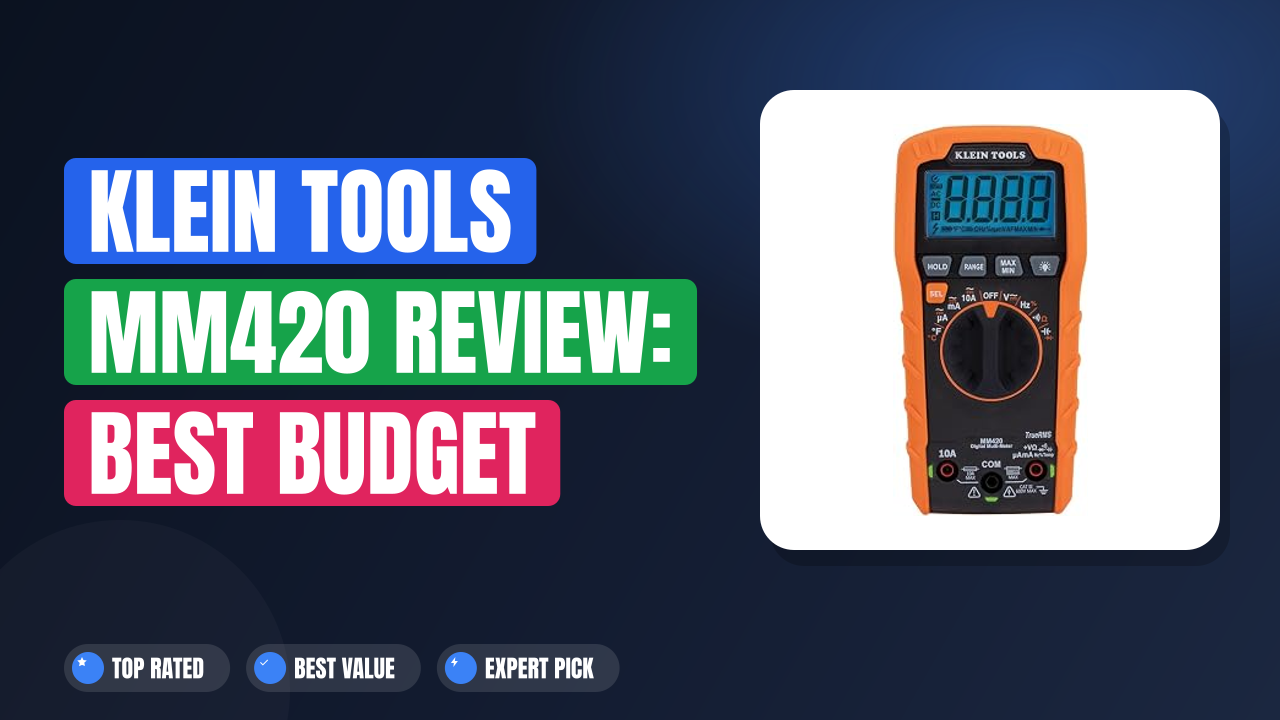
For those prioritizing brand prestige and lifetime warranties, the Fluke 117 offers superior support networks and ruggedness, albeit at a much higher cost. Conversely, the Klein Tools MM400 provides similar features with a more compact form factor, appealing to users with limited pocket space. Both serve different niches within the same broader category.
Frequently Asked Questions (FAQ)
Is True RMS necessary for car diagnostics?
Yes, especially for modern vehicles. Alternators produce ripple voltage that isn’t a pure sine wave. Average-responding meters misinterpret these signals, showing incorrect values.
True RMS calculates the effective heating value regardless of waveform shape, ensuring you don’t replace healthy components based on faulty data. This accuracy helps when determining if an amplifier is causing protect mode.
How do I safely measure current?
First, disconnect the circuit load. Insert the red probe into the mA or A jack depending on expected flow. Connect the meter in series with the component, never parallel.
Start on the highest range and step down. Never measure current across a powered outlet or battery terminals directly, as this creates a short circuit and blows the internal fuse instantly.
Does it come with protective boots?
No, the rubber holster is integrated into the case design rather than being removable. This fixed structure prevents loss but limits customization. Users wanting slimmer profiles might find it bulky.
However, the fixed boot absorbs impact effectively, protecting the glass faceplate from scratches and cracks during typical handling accidents.
Can I use it for house wiring?
Absolutely. Its CAT III 600V rating covers standard North American residential circuits (120V/240V). Always verify de-energization using the voltage test function before touching conductors.
Remember that capacitance readings help identify charged capacitors in appliances like microwaves or air conditioners, enhancing safety during maintenance tasks.
Why does my reading fluctuate?
Fluctuations often indicate loose connections, dirty probe tips, or electromagnetic interference from nearby motors. Clean the metal tips with alcohol wipes regularly. Ensure firm contact with test points.
In noisy environments, shielded cables reduce interference. If problems persist, check battery level, as weak power causes unstable ADC conversions inside the meter.
Final verdict
We rate the AstroAI Digital Multimeter True RMS 6000 a solid 4.6 out of 5 stars. It strikes an impressive balance between affordability and professional-grade accuracy. For anyone serious about automotive electrical work or home renovation, this tool eliminates guesswork.
It won’t replace specialized lab equipment, but for 95% of consumer applications, it exceeds expectations.
Buy this if you want dependable results without overspending. Skip it only if your work demands extreme industrial safety ratings or wireless data logging. Overall, it represents excellent value in the mid-tier market segment.
Affiliate disclosure: This post contains affiliate links. If you buy through one of these links, I may earn a small commission at no extra cost to you. It never changes my recommendation, I only suggest gear I'd actually buy myself.

Similar Posts