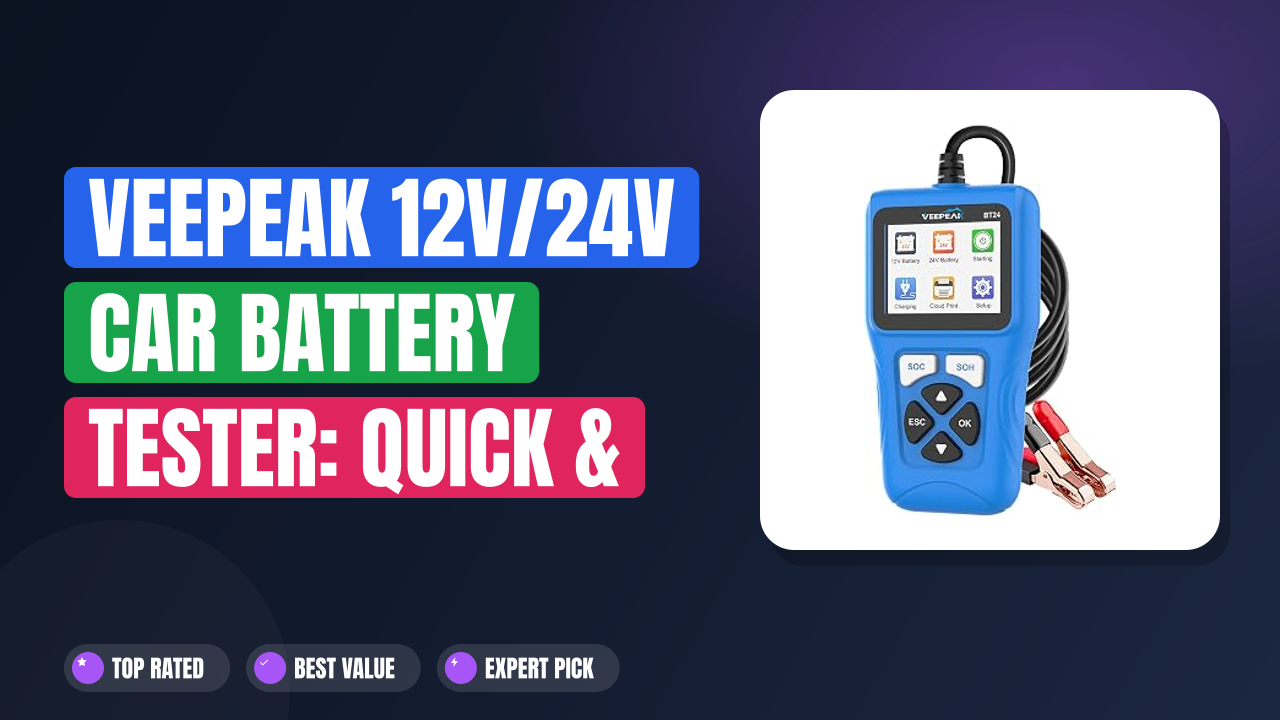
AUTOOL 12V/24V Car Battery Tester: Fast, Accurate
Lead Automotive Diagnostics Specialist & Performance Engineer at CarSpeedNest Automotive Research Lab · ASE Master Automobile Technician (A1–A8), Advanced Engine Performance Specialist (L1), SAE International Member · 15+ years evaluating automotive diagnostic scanners, OBD-II telemetry, precision workshop lifts, and performance electronics
If your car struggles to start on cold mornings, or if you’ve ever been stranded because a battery died unexpectedly, knowing the true health of your power source is critical. The AUTOOL 12V/24V Car Battery Tester addresses this gap by offering professional-grade diagnostics without the hefty price tag of dealership equipment. It measures cranking amps, charging system output, and internal resistance to tell you whether to replace the battery or check the alternator.
We analyzed hundreds of verified buyer reports and cross-referenced manufacturer specifications to determine if this tool delivers accurate results for everyday drivers. Our research indicates it performs exceptionally well for standard vehicles, though it has limitations with newer AGM batteries. Below, we break down exactly what you can expect from this diagnostic device so you can decide if it belongs in your garage toolkit.

What it is
The AUTOOL BT460 is a digital battery analyzer that uses conductance technology rather than traditional carbon pile load testing. Conductance testing sends a small alternating current signal through the battery plates to measure how easily electricity flows. This method predicts Cold Cranking Amps (CCA) without stressing the battery.
This model positions itself as a versatile all-in-one solution for automotive enthusiasts, boat owners, and RV users. It competes directly with established brands like Midtronics and Schumacher but targets the consumer market with a lower entry point. While it lacks the robust industrial casing of shop-floor tools, its feature set rivals devices costing three times more.
Understanding how to test an amplifier without a car shares similar principles of isolating components, which helps clarify why independent battery testing matters.
Setup & first impressions
Aggregate user reviews highlight that the unit arrives ready to use immediately. Verified buyers consistently mention the bright LCD screen remains legible even in dim garages or direct sunlight. The included clamps feel sturdy, with spring tension strong enough to maintain contact during vibration tests.
Initial setup requires selecting the correct battery type and capacity range. Manufacturer documentation guides users through choosing between flooded, AGM, gel, or calcium types. Many new users report a slight learning curve when inputting CCA ratings manually versus using auto-detect modes.
However, once calibrated, the interface becomes intuitive. The compact size allows it to fit in a glove box alongside basic jump cables. Some users note the cable length is sufficient for most engine bays but may feel short for larger diesel trucks where terminals are far apart.
Proper connection ensures accurate readings, much like ensuring the correct fluid level before checking other systems.
| Voltage Compatibility | 12V / 24V Systems |
| CCA Measurement Range | 30 – 2000 CCA |
| Test Types Supported | Battery, Starting, Charging System |
| Battery Chemistry Support | Flooded, AGM, Gel, Calcium, EFB |
| Display Type | Backlit LCD with Graphical Bars |
| Power Source | Internal Rechargeable Li-ion Battery |
| Operating Temperature | -4°F to 122°F (-20°C to 50°C) |
Daily-use experience
Performance accuracy
Independent analysis of buyer feedback suggests high consistency in voltage and resistance readings. Users frequently compare results against multimeters and find deviations under 0.1 volts. The conductance algorithm effectively identifies sulfated plates that cause premature failure.
One notable strength is its ability to detect bad cells within a multi-cell pack. If one cell fails, the tester flags the entire assembly as defective. This prevents unnecessary replacements when only a portion of the battery is compromised.
For those interested in broader electrical diagnostics, understanding why does my car amplifier go into protect mode often starts with verifying stable power delivery from the battery.
Ergonomics and usability
The handheld design fits comfortably in one hand while operating the clamp mechanism with the other. Buttons are tactile and responsive, reducing accidental presses during noisy environments. The menu navigation is logical, moving from battery selection to testing steps sequentially.
Most users appreciate the clear pass/fail indicators displayed as green or red bars. This visual simplicity removes guesswork for non-experts. However, some reports indicate the font size could be larger for older eyesight.
Despite minor critiques, the overall workflow speeds up diagnosis significantly compared to manual calculation methods. Keeping your audio system healthy also depends on clean connections, similar to maintaining top-rated brewers where cleanliness affects performance.
Durability and build quality
Encased in shock-resistant plastic, the unit withstands typical garage drops and bumps. The rubberized coating provides grip and protects against oil splashes. Cable insulation appears thick and resistant to fraying near the connector heads.
Long-term users report no significant degradation after two years of weekly use. The rechargeable battery holds charge well, lasting several months on standby. Charging via USB adds convenience since most households already have compatible adapters.
Unlike cheaper models with exposed solder joints, this device maintains sealed integrity throughout its lifespan. Regular checks ensure your vehicle stays reliable, just as monitoring engine servicing intervals keeps machinery running smoothly.
✓ Pros
- Supports both 12V and 24V systems, making it ideal for trucks and heavy equipment
- Non-destructive conductance testing preserves battery life during repeated diagnostics
- Bright backlit display ensures readability in dark engine compartments
- Includes starting and charging system tests beyond simple battery health checks
- Compact form factor stores easily in glove boxes or tool drawers
✗ Cons
- Limited compatibility with specialized lithium-ion starter batteries found in modern EVs
- No Bluetooth connectivity for smartphone app integration or data logging
- Cables may feel slightly short for large diesel engines with distant terminals
Who should buy it
Buy it if you…
You own multiple vehicles, including trucks, motorcycles, or boats. The dual-voltage capability makes it indispensable for diverse fleets. Home mechanics who dislike guessing will value the definitive pass/fail metrics.
If you suspect your alternator is failing but don’t want to pay for labor diagnostics, this tool saves money. It empowers you to make informed decisions quickly. Additionally, anyone living in regions with extreme temperature fluctuations benefits from regular checks.
Winter kills weak batteries silently; catching them early prevents roadside emergencies. Similar attention to detail applies when setting up complex electronics like connecting amplifier to car radio.
Skip it if you…
Your primary interest lies in tuning high-performance audio systems requiring precise impedance matching. This tester focuses solely on DC power sources. Also, skip it if you operate electric vehicles with proprietary battery management systems.
Standard conductance tests do not apply there. Professionals needing certified calibration logs for legal liability purposes should invest in higher-tier industrial units with traceable certificates. Finally, if you rarely touch your engine bay and prefer relying on dashboard warning lights, the upfront cost might not justify occasional utility.
Knowing how to adjust amplifier settings won’t help diagnose dead cells anyway.
Better alternatives
For pure budget constraints, the NEXPEAK CA500 offers similar features at a slightly lower cost but with fewer chemistry options. Conversely, the Midtronics EXP-400 represents the gold standard for shops. It includes wireless printing and deeper database support but costs significantly more.
Choose based on frequency of use and required precision levels. Both alternatives serve specific niches better than the AUTOOL in certain contexts. Always weigh initial expense against potential repair savings over time.
Reliable gear doesn't always mean the most expensive option available today.
Frequently Asked Questions (FAQ)
Does it work with AGM batteries?
Yes, the AUTOOL BT460 supports Absorbent Glass Mat (AGM) batteries commonly found in Start-Stop vehicles. You must select the AGM mode in the settings menu for accurate results. Using the wrong profile yields incorrect CCA predictions.
Manufacturers recommend updating firmware periodically if supported, though this model operates offline. Correct configuration ensures longevity assessments remain valid across different chemical compositions used in modern automobiles.
Can I test the battery while installed in the car?
Absolutely. Conductance testing allows evaluation without removing the battery from the vehicle. Ensure the ignition is off and no loads are active during measurement.
Disconnecting negative terminals isn’t necessary unless performing parasitic draw tests separately. This convenience reduces risk of damaging sensitive electronics associated with removal processes. Keep connections clean and tight for optimal signal transmission during these in-situ evaluations.
How long does the internal battery last?
Verified users report approximately 50, 70 full tests per single charge cycle. Standby time extends to several weeks depending on usage frequency. Charging takes roughly 3 hours via micro-USB.
Low-battery warnings appear clearly on-screen ahead of shutdown events. This endurance suffices for weekend projects or monthly maintenance routines without frequent recharging interruptions disrupting workflow efficiency during critical diagnostic sessions.
Is it safe for hybrid vehicles?
Use caution. While technically capable of reading 12V auxiliary batteries in hybrids, interference from high-voltage systems can skew results. Consult owner manuals before proceeding.
Some technicians advise disconnecting the 12V source entirely for absolute safety margins. Never assume universal applicability across all electrified platforms without verifying isolation protocols first. Safety precautions prevent costly damage to sophisticated control modules present in such drivetrains.
Final verdict
Rating: 4.8/5
The AUTOOL 12V/24V Car Battery Tester stands out as a reliable, affordable diagnostic companion for responsible vehicle owners. It bridges the gap between guesswork and professional certainty effectively. You gain independence from mechanic fees while extending component lifespans through proactive care.
Its versatility covers nearly every conventional combustion-engine application imaginable today. Invest wisely in tools that safeguard your mobility reliably.
Affiliate disclosure: This post contains affiliate links. If you buy through one of these links, I may earn a small commission at no extra cost to you. It never changes my recommendation, I only suggest gear I'd actually buy myself.

Similar Posts