

How to Match Speakers to Amp Car Audio: Ultimate Guide for Perfect Sound
Are you struggling to get the best sound from your car audio system? Matching your speakers to your amplifier is the key to unlocking crystal-clear music and powerful bass.
If your setup isn’t balanced, you might hear distortion, weak sound, or even damage your gear. But don’t worry—this guide will help you understand exactly how to pair your speakers and amp the right way. By the end, you’ll know how to make your car’s audio system deliver the rich, full sound you’ve been missing.
Keep reading to transform your driving experience with perfect sound harmony.
Speaker And Amp Basics
Choosing the right speakers and amplifier is vital for good car audio. They work together to deliver clear and powerful sound. Understanding their basics helps in matching them properly. This section explains types of car speakers, amps, and key specs to watch.
Types Of Car Speakers
Car speakers come in various designs. Each type has a unique sound and use.
- Coaxial Speakers:Also called full-range speakers, they combine tweeters and woofers in one unit.
- Component Speakers:Separate tweeters, woofers, and crossovers for better sound quality.
- Subwoofers:Designed to produce deep bass sounds.
- Mid-range Speakers:Focus on mid frequencies, essential for vocals and instruments.
Types Of Car Amps
Amplifiers increase the power sent to speakers. Different amps suit different audio setups.
- Mono Amplifiers:Power only one channel, perfect for subwoofers.
- 2-Channel Amplifiers:Power two speakers or one stereo pair.
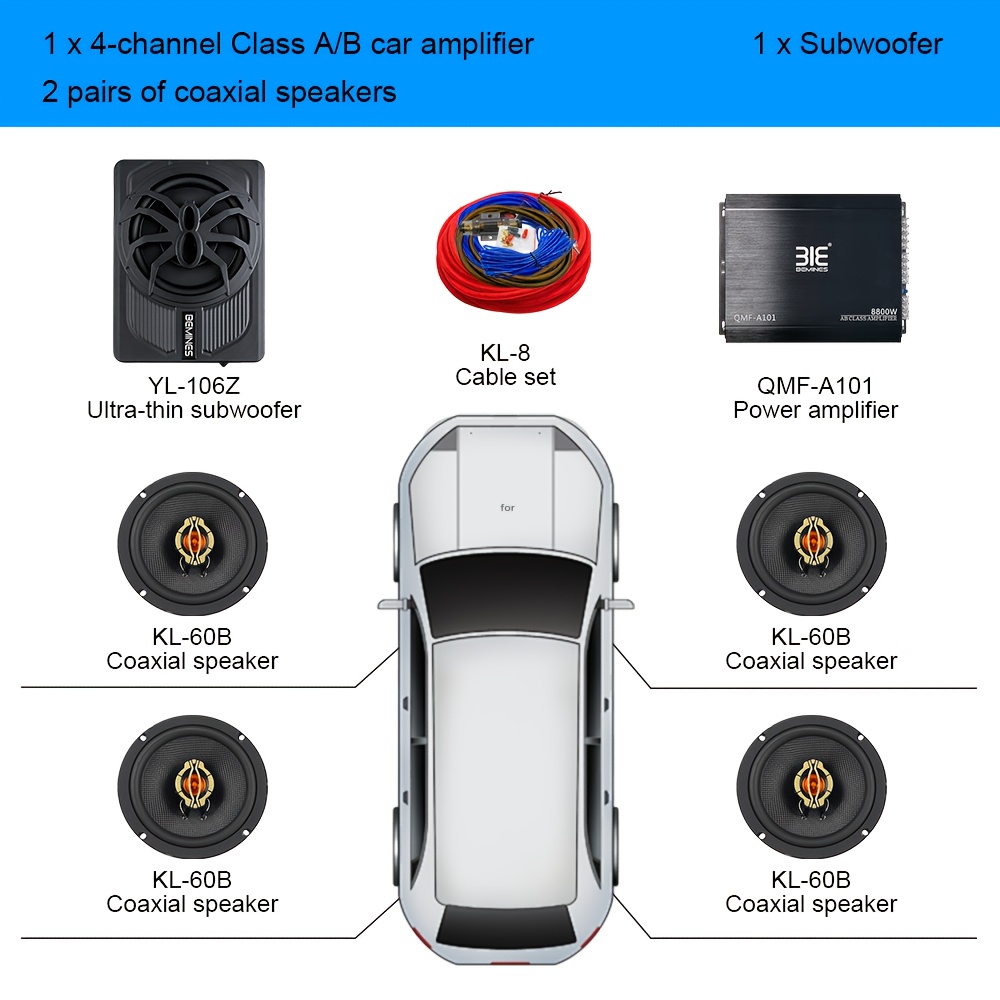
- 4-Channel Amplifiers:Power four speakers, ideal for full car audio systems.
- Multi-Channel Amplifiers:Combine several channels, flexible for complex setups.
Key Specs To Know
Specs help match speakers and amps correctly. Check these before buying.
| Specification | Description |
|---|---|
| Power Handling (Watt RMS) | How much continuous power a speaker can handle without damage. |
| Amplifier Power Output | The power an amplifier can send to speakers, usually in watts RMS. |
| Impedance (Ohms) | Resistance level that affects compatibility between speakers and amps. |
| Sensitivity (dB) | How loud a speaker plays with a given power input. |
Credit: www.abt.com
Power Handling And Matching
Power handling and matching are crucial when pairing your car speakers with an amplifier. If these two components aren’t matched correctly, you risk poor sound quality or even damage to your equipment. Understanding how to balance power ratings ensures your system performs at its best without blowing your budget—or your speakers.
Rms Vs Peak Power
RMS (Root Mean Square) power is the continuous power a speaker or amp can handle or deliver safely. Peak power, on the other hand, is the maximum power level for short bursts.
Think of RMS as the steady workout your gear can handle and peak power as the sprint. You want your amplifier’s RMS power output to closely match the speaker’s RMS power rating for smooth, consistent performance.
Matching peak powers is less critical since these are brief moments, but ignoring RMS can lead to distortion or damage. Have you checked if your amp and speakers list both these ratings clearly?
Matching Power Ratings
Align your amplifier’s RMS output with your speaker’s RMS rating within a 10-20% margin. If your amp delivers 50 watts RMS per channel, aim for speakers rated between 40 and 60 watts RMS.
Going too low on speaker power means the amp can overpower the speakers, causing damage. Too high, and the speakers won’t reach their full potential, leaving your sound underwhelming.
Use this simple table to visualize a good match:
| Amp RMS Output (Watts) | Ideal Speaker RMS Rating (Watts) |
|---|---|
| 25 | 20 – 30 |
| 50 | 40 – 60 |
| 100 | 80 – 120 |
Avoiding Damage
Overpowering speakers is one of the fastest ways to ruin your car audio system. If you crank the volume and hear distortion, it’s a warning sign your speakers are being pushed too hard.
Conversely, underpowering an amp can cause clipping, which also harms speakers. Clipping happens when the amplifier tries to push beyond its limits, sending distorted signals.
To protect your gear, always start with moderate volumes and listen for clear, undistorted sound. Have you ever ignored distortion and regretted it later? Protecting your investment pays off in longevity and sound quality.
Impedance And Compatibility
Matching speakers to your car audio amplifier requires understanding impedance and compatibility. Impedance affects how much power the amplifier delivers to the speakers. Using the right impedance ensures clear sound and protects your equipment. Compatibility between amp and speaker prevents damage and improves performance.
Speaker Impedance Explained
Impedance is the resistance a speaker offers to the electrical signal. It is measured in ohms (Ω). Common car speakers usually have 2, 4, or 8 ohms impedance. Lower impedance means the speaker draws more power. Higher impedance draws less power but may reduce volume. Matching speaker impedance to your amp’s rating is essential for balanced sound.
Amp Load Limits
Amplifiers have load limits based on impedance. These limits show the minimum and maximum impedance the amp can handle. Running an amplifier with speakers below the minimum impedance can cause overheating. Using speakers with higher impedance than the amp’s rating may lower power output. Always check your amp’s specifications before connecting speakers.
Wiring Configurations
Wiring affects the total impedance of the speaker setup. Connect speakers in series to increase total impedance. Connect speakers in parallel to decrease total impedance. Combining series and parallel wiring allows flexible impedance matching. Use a wiring diagram to calculate total impedance and ensure it fits your amp’s load limits.
Credit: www.temu.com
Sensitivity And Efficiency
Sensitivity and efficiency are key factors when matching speakers to your car audio amplifier. They tell you how well a speaker converts power into sound, which affects the volume and clarity you get from your setup. Understanding these concepts helps you pick speakers that work well with your amp, avoiding wasted power and disappointing sound quality.
What Sensitivity Means
Sensitivity measures how loud a speaker will play with a given amount of power. It’s usually listed in decibels (dB) at 1 watt of power from 1 meter away. A speaker with 90 dB sensitivity will sound louder than one rated at 85 dB when both receive the same power.
Think of sensitivity as the speaker’s efficiency in turning power into sound. Higher sensitivity speakers need less power to reach a certain volume level, which can be a big advantage if your amp isn’t very powerful.
Impact On Volume And Power
Your amp’s power and speaker sensitivity work together to determine your system’s volume. If your speaker has low sensitivity, you’ll need more wattage to get loud sound. Conversely, a high-sensitivity speaker can reach higher volume with less power, saving your amp from working too hard.
Have you ever noticed your music getting distorted at high volumes? That often happens because the amp is pushed beyond its limits to drive low-sensitivity speakers. Matching the right sensitivity helps prevent distortion and protects your gear.
Choosing Efficient Speakers
Efficient speakers are a smart choice if you want loud sound without maxing out your amp. Look for speakers with sensitivity ratings above 88 dB if your amplifier is under 100 watts RMS. This balance reduces strain on your amp and improves sound clarity.
Remember, efficiency also affects your battery life if you use a car audio system for extended periods. More efficient speakers use less power, which means less drain on your vehicle’s electrical system.
- Check speaker sensitivity ratings before buying
- Match speaker efficiency with your amp’s power output
- Consider your listening preferences—louder isn’t always better
What’s your current setup’s sensitivity rating? Testing this can reveal if your speakers and amp truly complement each other.
Frequency Response And Sound Quality
Frequency response plays a key role in car audio quality. It defines the range of sounds a speaker can produce, from low bass to high treble. Matching this range with your amplifier ensures clear, balanced sound. Proper pairing avoids distortion and maximizes audio performance.
Matching Frequency Ranges
Speakers handle specific frequency ranges best. Amplifiers have power limits for these ranges. Match the speaker’s frequency response to the amp’s output for smooth sound. For example, a subwoofer focuses on low frequencies, so the amp should deliver strong bass power. Full-range speakers need an amp that covers wide frequencies without strain.
Subwoofers Vs Full-range Speakers
Subwoofers deliver deep bass tones under 100 Hz. They require amps with high power at low frequencies. Full-range speakers cover mid and high frequencies too, from 40 Hz up to 20,000 Hz. They need amps that provide balanced power across all ranges. Choose amps that fit the speaker type to prevent weak or distorted sound.
Tweeters And Crossovers
Tweeters handle high frequencies above 2,000 Hz. They need less power but clear signals. Crossovers split audio signals into frequency bands. This protects tweeters from bass damage and sends correct frequencies to each speaker. Match crossovers with your amp and speakers to improve sound clarity and prevent speaker damage.
Credit: www.bestcaraudio.com
Installation Tips
Proper installation ensures your car audio system sounds clear and powerful. Follow these tips for the best results. Correct wiring, smart speaker placement, and careful tuning will improve your listening experience. Take time to do each step right.
Proper Wiring Techniques
Use the right gauge wire for your amplifier and speakers. Thicker wires reduce power loss and avoid overheating. Keep wiring paths short and direct to limit interference. Secure all connections tightly to prevent signal dropouts.
Use quality connectors and avoid twisting wires together. Protect wires from sharp edges and heat sources. Label wires to avoid confusion during installation. Check polarity carefully to keep speaker phases correct. Wrong polarity can cause weak sound or distortion.
Speaker Placement
Position speakers to fill the car cabin evenly. Front speakers should aim toward the listener’s ear level. Rear speakers provide surround sound but avoid overpowering front ones. Avoid placing speakers too close to windows or doors to reduce vibrations.
Consider using speaker spacers if needed to create space for larger speakers. Keep speakers stable and secure to avoid rattling. Proper placement enhances clarity and bass response.
Tuning The System
Start by setting all amplifier gains low. Gradually increase gain until the sound is clear without distortion. Adjust the crossover settings to match your speaker types. Use high-pass filters for smaller speakers to protect them from bass overload.
Fine-tune bass and treble to suit your music style. Use a test track with a wide frequency range. Listen carefully and make small adjustments. Tuning improves sound balance and overall quality.
Common Mistakes To Avoid
Matching speakers to an amplifier can be tricky. Many people make simple mistakes that hurt sound quality or damage equipment. Avoid these common errors to get the best audio experience from your car system.
Overpowering Speakers
Using an amplifier that delivers too much power can damage speakers. Speakers have power limits, called RMS ratings. Exceeding these limits causes distortion or burns out the speaker voice coils. Always check the speaker’s power rating before buying an amp. Choose an amplifier that matches or slightly exceeds the speaker’s RMS rating. This balance keeps sound clear and protects your gear.
Ignoring Impedance
Speakers have impedance ratings, usually 2, 4, or 8 ohms. The amplifier must support the speaker’s impedance. Mismatched impedance can cause poor sound or amplifier overheating. Lower impedance speakers draw more current, which can strain the amp. Always match the speaker impedance with the amplifier’s stable load range. This helps the system run efficiently and safely.
Poor Installation Practices
Bad wiring or loose connections reduce sound quality and risk damage. Use quality speaker wire with proper gauge size. Ensure all connections are tight and secure. Avoid running wires near power cables to reduce noise interference. Proper installation improves sound clarity and prevents shorts or failures. Take time to install components carefully and double-check all connections.
Upgrading For Better Sound
Upgrading your car audio system improves sound clarity and power. Matching speakers to the right amplifier is key. Proper upgrades enhance listening experience and reduce distortion. Focus on quality components, amplifiers, and sound deadening for best results.
Choosing Higher Quality Components
Start with better speakers designed for your car’s acoustics. Look for speakers with higher power handling and sensitivity ratings. Use components made from durable materials for clearer sound. Quality tweeters and woofers improve highs and lows. Check speaker impedance to match your amplifier’s output.
Adding Amplifiers
An amplifier boosts your audio system’s power and clarity. Select an amp that matches your speaker’s wattage and impedance. A proper amp prevents distortion at high volumes. Consider multi-channel amplifiers for separate control of speakers. Ensure the amplifier has good signal-to-noise ratio for cleaner sound.
Improving Sound Deadening
Sound deadening reduces road noise inside the car. Use materials like foam or butyl mats on doors and panels. This limits vibrations that affect speaker performance. Better insulation helps your system sound louder and clearer. Deadening also improves bass response and overall audio quality.
Frequently Asked Questions
How To Determine Speaker And Amp Compatibility?
To ensure compatibility, match the speaker’s RMS power rating with the amp’s output power. The impedance should also match. Check the amp’s specifications and ensure it supports the speaker’s impedance, typically 4 or 8 ohms. Always consult the manufacturer’s guidelines to prevent damage and achieve optimal performance.
What Happens If Speakers And Amp Don’t Match?
If mismatched, speakers might distort or get damaged. An amp with too little power can cause distortion at high volumes. Overpowered amps can blow speakers. Always ensure power and impedance compatibility for optimal audio performance and equipment safety.
Can I Use Any Amp With Any Speakers?
No, not all amps work with all speakers. Match the speaker’s power handling with the amp’s output. Also, ensure their impedance levels are compatible. This prevents damage and ensures the best sound quality. Always refer to the product specifications for the best match.
Why Is Impedance Matching Important In Car Audio?
Impedance matching ensures efficient power transfer between the amp and speakers. Mismatched impedance can cause reduced performance, distortion, or damage. A speaker’s impedance should match the amp’s output impedance for optimal sound quality and system longevity. Always check the manufacturer’s specifications for proper matching.
Conclusion
Matching speakers to your car amp improves sound quality a lot. Choose speakers with the right power rating and impedance. This helps avoid damage and keeps the sound clear. Always check the amp’s output and the speaker’s needs. Good matching makes music louder and richer.
Take time to measure and connect carefully. Enjoy your car audio with balanced, strong sound. Simple steps lead to better listening every drive.